 Add to Chrome
 Add to Firefox
 Add to Edge
LT2: Linear-Time Looped Transformers
May 20, 2026
Looped Transformers (LT) have emerged as a powerful architecture by iterating their layers multiple times before decoding the final token. However, pairing them with full attention retains quadratic complexity, making them computationally expensive and slow. We introduce LT2 (Linear-Time Looped Transformers), a family of looped architectures that replace quadratic softmax attention with subquadratic, linear-time attention. We study two variants: LT2-linear with linear attention and LT2-sparse with sparse attention. We find that looping uniquely synergizes with these variants: it enables iterative memory refinement in linear attention and progressively expands the effective receptive field in sparse attention. We formalize these benefits theoretically and demonstrate consistent empirical gains across controlled recall, state-tracking, and language modeling tasks. We then explore LT2-hybrid, which combines different attention variants in a looped setting. Two variants are especially promising: LT2-hybrid (GDN+DSA), which interleaves linear and sparse attention to maximize efficiency and matches the standard looped transformer's quality at fully linear-time cost; and LT2-hybrid (Full+GDN), which interleaves GDN with a small fraction of full attention layers to maximize quality, surpassing the standard looped transformer in both performance and efficiency. We also show how to convert a pre-trained LT into an LT2-hybrid model. With about 1B tokens of training, our converted model, Ouro-hybrid-1.4B, outperforms industry-level 1B models and is competitive with industry-level 4B models while retaining the speed benefits of linear-time attention. Together, these results show a clear path toward making looped transformers more scalable and advancing efficient, capable small language models.

Transformers with Selective Access to Early Representations
May 05, 2026Several recent Transformer architectures expose later layers to representations computed in the earliest layers, motivated by the observation that low-level features can become harder to recover as the residual stream is repeatedly transformed through depth. The cheapest among these methods add static value residuals: learned mixing coefficients that expose the first-layer value projection V_1 uniformly across tokens and heads. More expressive dense or dynamic alternatives recover finer-grained access, but at higher memory cost and lower throughput. The usefulness of V_1 is unlikely to be constant across tokens, heads, and contexts; different positions plausibly require different amounts of access to early lexical or semantic information. We therefore treat early-representation reuse as a retrieval problem rather than a connectivity problem, and introduce Selective Access Transformer (SATFormer), which preserves the first-layer value pathway while controlling access with a context-dependent gate. Across models from 130M to 1.3B parameters, SATFormer consistently improves validation loss and zero-shot accuracy over the static value-residual and Transformer baselines. Its strongest gains appear on retrieval-intensive benchmarks, where it improves over static value residuals by approximately 1.5 average points, while maintaining throughput and memory usage close to the baseline Transformer. Gate analyses suggest sparse, depth-dependent, head-specific, and category-sensitive access patterns, supporting the interpretation that SATFormer learns selective reuse of early representations rather than uniform residual copying. Our code is available at https://github.com/SkyeGunasekaran/SATFormer.
Nexusformer: Nonlinear Attention Expansion for Stable and Inheritable Transformer Scaling
Apr 21, 2026Scaling Transformers typically necessitates training larger models from scratch, as standard architectures struggle to expand without discarding learned representations. We identify the primary bottleneck in the attention mechanism's linear projections, which strictly confine feature extraction to fixed-dimensional subspaces, limiting both expressivity and incremental capacity. To address this, we introduce Nexusformer, which replaces linear $Q/K/V$ projections with a Nexus-Rank layer, a three-stage nonlinear mapping driven by dual activations in progressively higher dimensional spaces. This design overcomes the linearity constraint and enables lossless structured growth: new capacity can be injected along two axes via zero-initialized blocks that preserve pretrained knowledge. Experiments on language modeling and reasoning benchmarks demonstrate that Nexusformer matches Tokenformer's perplexity using up to 41.5\% less training compute during progressive scaling (240M to 440M). Furthermore, our analysis of growth dynamics reveals that zero initialization induces a stable convergence trajectory, allowing us to derive a geometric scaling law that accurately predicts performance across expansion scales.
LoopViT: Scaling Visual ARC with Looped Transformers
Feb 02, 2026Recent advances in visual reasoning have leveraged vision transformers to tackle the ARC-AGI benchmark. However, we argue that the feed-forward architecture, where computational depth is strictly bound to parameter size, falls short of capturing the iterative, algorithmic nature of human induction. In this work, we propose a recursive architecture called Loop-ViT, which decouples reasoning depth from model capacity through weight-tied recurrence. Loop-ViT iterates a weight-tied Hybrid Block, combining local convolutions and global attention, to form a latent chain of thought. Crucially, we introduce a parameter-free Dynamic Exit mechanism based on predictive entropy: the model halts inference when its internal state ``crystallizes" into a low-uncertainty attractor. Empirical results on the ARC-AGI-1 benchmark validate this perspective: our 18M model achieves 65.8% accuracy, outperforming massive 73M-parameter ensembles. These findings demonstrate that adaptive iterative computation offers a far more efficient scaling axis for visual reasoning than simply increasing network width. The code is available at https://github.com/WenjieShu/LoopViT.
Dynamic Large Concept Models: Latent Reasoning in an Adaptive Semantic Space
Dec 31, 2025Large Language Models (LLMs) apply uniform computation to all tokens, despite language exhibiting highly non-uniform information density. This token-uniform regime wastes capacity on locally predictable spans while under-allocating computation to semantically critical transitions. We propose $\textbf{Dynamic Large Concept Models (DLCM)}$, a hierarchical language modeling framework that learns semantic boundaries from latent representations and shifts computation from tokens to a compressed concept space where reasoning is more efficient. DLCM discovers variable-length concepts end-to-end without relying on predefined linguistic units. Hierarchical compression fundamentally changes scaling behavior. We introduce the first $\textbf{compression-aware scaling law}$, which disentangles token-level capacity, concept-level reasoning capacity, and compression ratio, enabling principled compute allocation under fixed FLOPs. To stably train this heterogeneous architecture, we further develop a $\textbf{decoupled $μ$P parametrization}$ that supports zero-shot hyperparameter transfer across widths and compression regimes. At a practical setting ($R=4$, corresponding to an average of four tokens per concept), DLCM reallocates roughly one-third of inference compute into a higher-capacity reasoning backbone, achieving a $\textbf{+2.69$\%$ average improvement}$ across 12 zero-shot benchmarks under matched inference FLOPs.
Scaling Latent Reasoning via Looped Language Models
Oct 29, 2025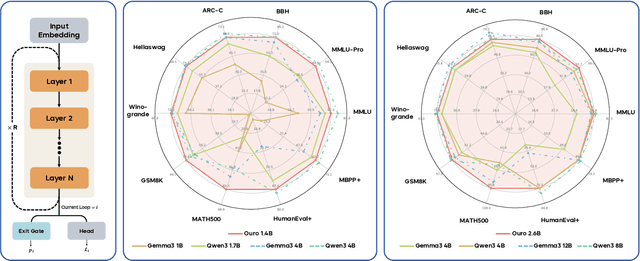
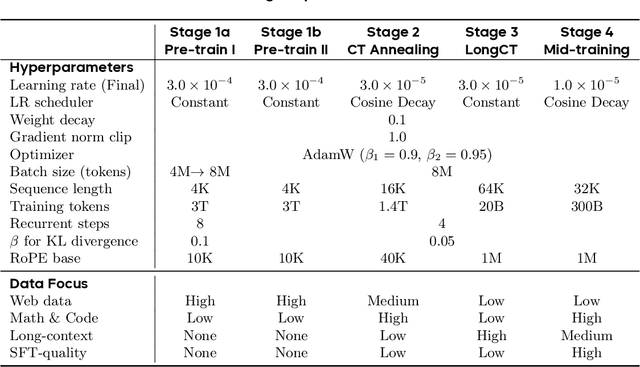
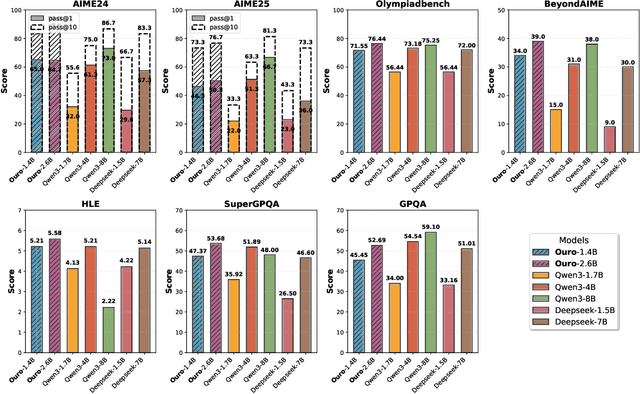

Modern LLMs are trained to "think" primarily via explicit text generation, such as chain-of-thought (CoT), which defers reasoning to post-training and under-leverages pre-training data. We present and open-source Ouro, named after the recursive Ouroboros, a family of pre-trained Looped Language Models (LoopLM) that instead build reasoning into the pre-training phase through (i) iterative computation in latent space, (ii) an entropy-regularized objective for learned depth allocation, and (iii) scaling to 7.7T tokens. Ouro 1.4B and 2.6B models enjoy superior performance that match the results of up to 12B SOTA LLMs across a wide range of benchmarks. Through controlled experiments, we show this advantage stems not from increased knowledge capacity, but from superior knowledge manipulation capabilities. We also show that LoopLM yields reasoning traces more aligned with final outputs than explicit CoT. We hope our results show the potential of LoopLM as a novel scaling direction in the reasoning era. Our model could be found in: http://ouro-llm.github.io.
A Systematic Analysis of Hybrid Linear Attention
Jul 08, 2025Transformers face quadratic complexity and memory issues with long sequences, prompting the adoption of linear attention mechanisms using fixed-size hidden states. However, linear models often suffer from limited recall performance, leading to hybrid architectures that combine linear and full attention layers. Despite extensive hybrid architecture research, the choice of linear attention component has not been deeply explored. We systematically evaluate various linear attention models across generations - vector recurrences to advanced gating mechanisms - both standalone and hybridized. To enable this comprehensive analysis, we trained and open-sourced 72 models: 36 at 340M parameters (20B tokens) and 36 at 1.3B parameters (100B tokens), covering six linear attention variants across five hybridization ratios. Benchmarking on standard language modeling and recall tasks reveals that superior standalone linear models do not necessarily excel in hybrids. While language modeling remains stable across linear-to-full attention ratios, recall significantly improves with increased full attention layers, particularly below a 3:1 ratio. Our study highlights selective gating, hierarchical recurrence, and controlled forgetting as critical for effective hybrid models. We recommend architectures such as HGRN-2 or GatedDeltaNet with a linear-to-full ratio between 3:1 and 6:1 to achieve Transformer-level recall efficiently. Our models are open-sourced at https://huggingface.co/collections/m-a-p/hybrid-linear-attention-research-686c488a63d609d2f20e2b1e.
A Survey on Latent Reasoning
Jul 08, 2025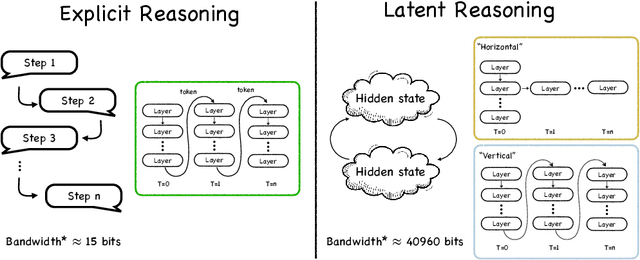

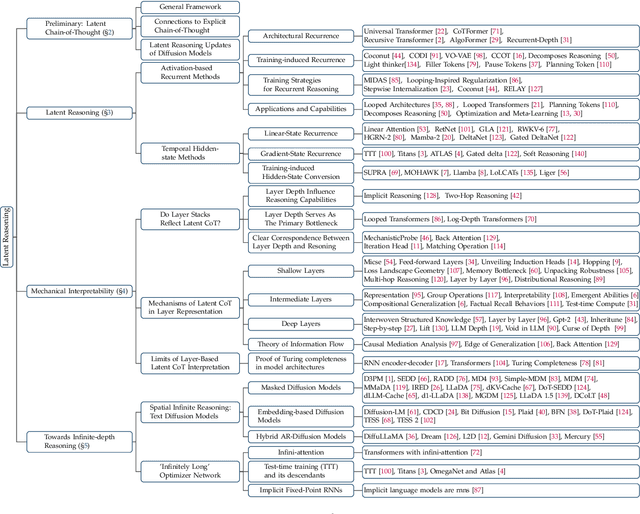
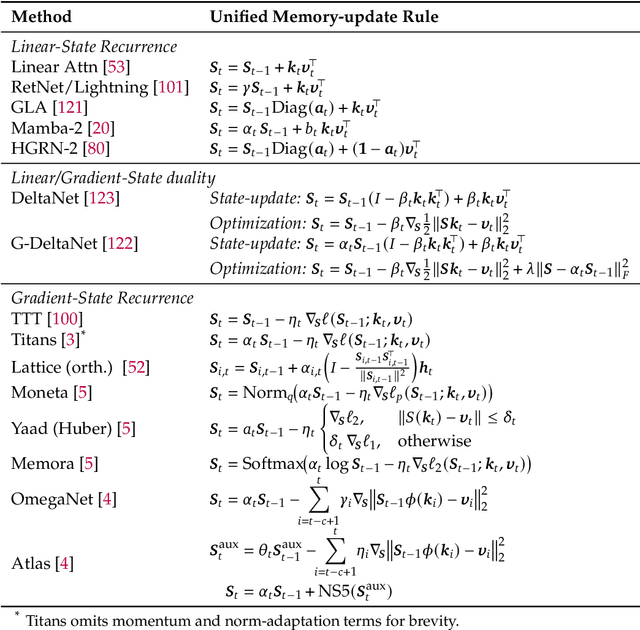
Large Language Models (LLMs) have demonstrated impressive reasoning capabilities, especially when guided by explicit chain-of-thought (CoT) reasoning that verbalizes intermediate steps. While CoT improves both interpretability and accuracy, its dependence on natural language reasoning limits the model's expressive bandwidth. Latent reasoning tackles this bottleneck by performing multi-step inference entirely in the model's continuous hidden state, eliminating token-level supervision. To advance latent reasoning research, this survey provides a comprehensive overview of the emerging field of latent reasoning. We begin by examining the foundational role of neural network layers as the computational substrate for reasoning, highlighting how hierarchical representations support complex transformations. Next, we explore diverse latent reasoning methodologies, including activation-based recurrence, hidden state propagation, and fine-tuning strategies that compress or internalize explicit reasoning traces. Finally, we discuss advanced paradigms such as infinite-depth latent reasoning via masked diffusion models, which enable globally consistent and reversible reasoning processes. By unifying these perspectives, we aim to clarify the conceptual landscape of latent reasoning and chart future directions for research at the frontier of LLM cognition. An associated GitHub repository collecting the latest papers and repos is available at: https://github.com/multimodal-art-projection/LatentCoT-Horizon/.
ARFlow: Autogressive Flow with Hybrid Linear Attention
Jan 27, 2025


Flow models are effective at progressively generating realistic images, but they generally struggle to capture long-range dependencies during the generation process as they compress all the information from previous time steps into a single corrupted image. To address this limitation, we propose integrating autoregressive modeling -- known for its excellence in modeling complex, high-dimensional joint probability distributions -- into flow models. During training, at each step, we construct causally-ordered sequences by sampling multiple images from the same semantic category and applying different levels of noise, where images with higher noise levels serve as causal predecessors to those with lower noise levels. This design enables the model to learn broader category-level variations while maintaining proper causal relationships in the flow process. During generation, the model autoregressively conditions the previously generated images from earlier denoising steps, forming a contextual and coherent generation trajectory. Additionally, we design a customized hybrid linear attention mechanism tailored to our modeling approach to enhance computational efficiency. Our approach, termed ARFlow, under 400k training steps, achieves 14.08 FID scores on ImageNet at 128 * 128 without classifier-free guidance, reaching 4.34 FID with classifier-free guidance 1.5, significantly outperforming the previous flow-based model SiT's 9.17 FID. Extensive ablation studies demonstrate the effectiveness of our modeling strategy and chunk-wise attention design.
Future-Guided Learning: A Predictive Approach To Enhance Time-Series Forecasting
Oct 19, 2024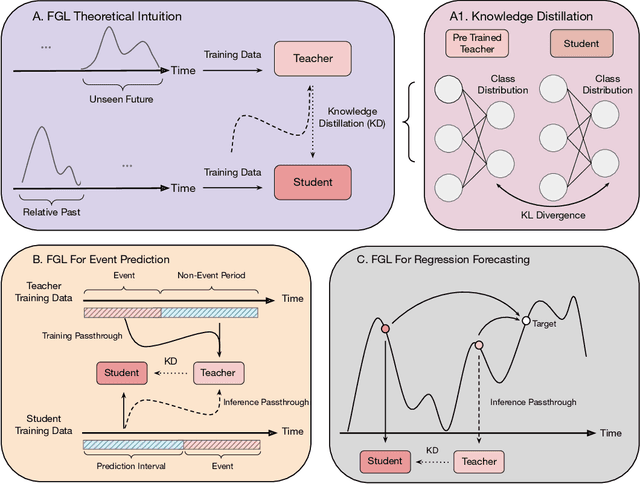
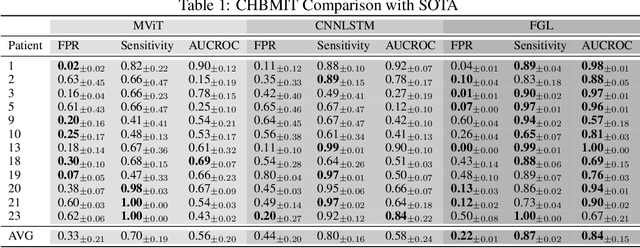
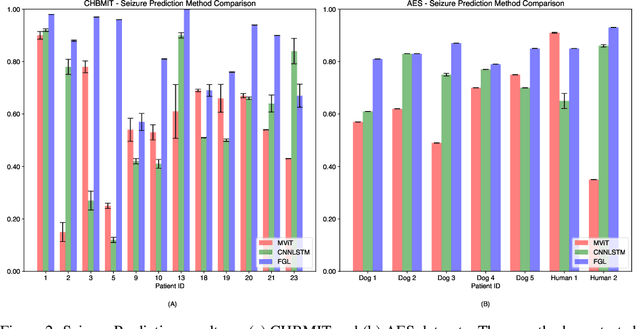
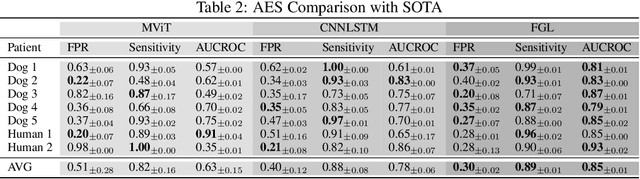
Accurate time-series forecasting is essential across a multitude of scientific and industrial domains, yet deep learning models often struggle with challenges such as capturing long-term dependencies and adapting to drift in data distributions over time. We introduce Future-Guided Learning, an approach that enhances time-series event forecasting through a dynamic feedback mechanism inspired by predictive coding. Our approach involves two models: a detection model that analyzes future data to identify critical events and a forecasting model that predicts these events based on present data. When discrepancies arise between the forecasting and detection models, the forecasting model undergoes more substantial updates, effectively minimizing surprise and adapting to shifts in the data distribution by aligning its predictions with actual future outcomes. This feedback loop, drawing upon principles of predictive coding, enables the forecasting model to dynamically adjust its parameters, improving accuracy by focusing on features that remain relevant despite changes in the underlying data. We validate our method on a variety of tasks such as seizure prediction in biomedical signal analysis and forecasting in dynamical systems, achieving a 40\% increase in the area under the receiver operating characteristic curve (AUC-ROC) and a 10\% reduction in mean absolute error (MAE), respectively. By incorporating a predictive feedback mechanism that adapts to data distribution drift, Future-Guided Learning offers a promising avenue for advancing time-series forecasting with deep learning.